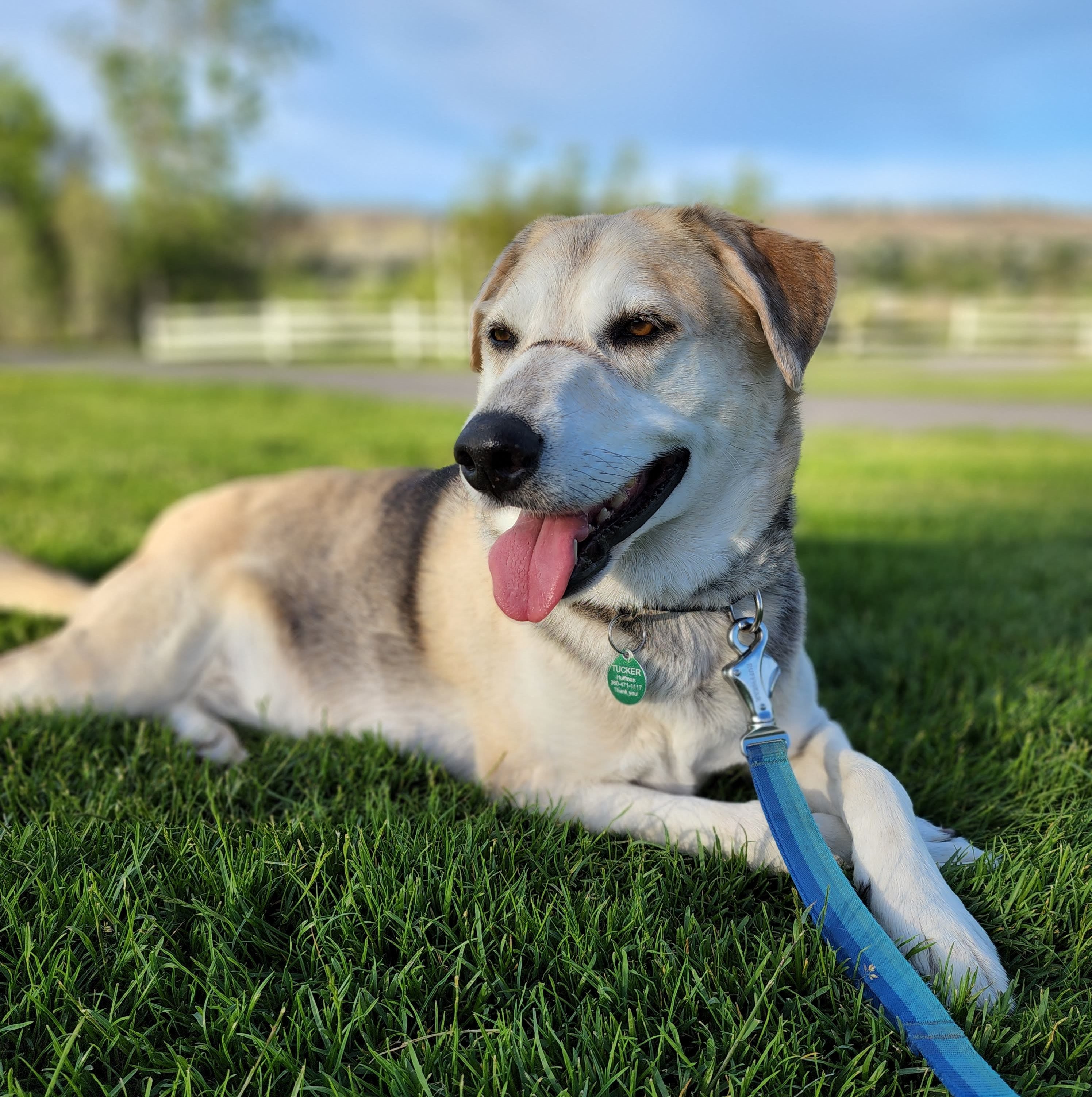
Walking with Tucker has been an adventure in everything that mindful awareness teaches us. Our daily walks have gone from trying to rein him in, constantly being on alert for things that he was strongly reactive to, paying constant attention to our surroundings so I could anticipate him jumping or lunging, plus just the speed – go go go walks. When we first adopted him, he had almost no leash training (contrary to what the humane society said, but they had him medicated when they were walking him…so there’s that).
We spent time trying to find the best harness for walking him and finally settled on a gentle leader after many failed attempts at other harnesses – turns out that Tucker has a high pain threshold so any that relied on pain or discomfort to alter his walking behavior simply did not register. But the gentle leader did the trick. It was, indeed, easier to control the 10 pound head rather than the full 85 pound body, especially when he went “nose to the ground” after a scent and all other brain functions just basically turned off.
But over the years, everything changed – as all things do eventually. From the young dog with wild energy to now, the old man dog, limping and panting and just doing his best to enjoy his life and getting the most out of his daily walks.
Tucker has been with me on this most recent phase of my mindfulness journey. He was there when my son left home. And suddenly, my walks became something different – part of the grieving process that slowly transformed into an active mindfulness practice.
The other way Tucker has helped me along my mindfulness journey is through slowing me down. Over the past year, his age has really caught up with him. He has osteoarthritis, which has become really noticeable on his back legs where his ankles are in a nearly constant swollen state. He can’t walk nearly as fast as he used to and needs to take more breaks and just really slow it all down. So that was a huge challenge for me!
I used to commute via walking to catch the ferry in Seattle to get home to Bremerton – the ferry ride is an hour long and you DO NOT want to miss it because then it’s another hour for the next ferry. Long evenings if it’s missed. So I power-walked from the office at the north end of the Seattle waterfront to the ferry – and when you’re going against the tide of visitors who are just ambling along, enjoying their slow strolls, the stress in me went higher and higher. But that also became “how I walked” pretty much everywhere – fast and with a purpose of getting to my destination.
So when Tucker was younger, our pace worked out pretty well. He did have to slow down a bit, but we walked at a pretty good clip – light cardio daily. So when his health took a hit, and it came kinda fast and sudden (or at least, my awareness of it did), it took me quite a while to figure out how to walk slow.
One doesn’t really have a choice sometimes when the Universe demands you slow down. So the question became how to “tolerate” it. How to allow it. Even how to embrace it.
When it first became obvious that Tucker just COULD NOT walk any faster, I was impatient, constantly urging him on, to go a bit faster. The ever present, “Come on!” was a constant during are multiple daily walks. I was no longer looking forward to them. They were no longer serving ME.
But they were serving Tucker. And they were, after all, HIS walks. I was just there to make sure he didn’t wander off, after all. So a couple of things slowly started shifting.
First, I accepted that they were his walks and that I needed to adapt to his needs. It started in small, silly ways. Every “Come on” statement started growing:
Come on, babe.
Come on, babe, why don’t we paint the town?
Come on, babe, why don’t we paint the town…and all that jazz!
You can see where this is going…I decided I would just learn the lyrics to All That Jazz so that while we were walking and with every “Come on” that came out of me, I would just let it flow into the song…a shift. Now it wasn’t about urging him faster; I was learning a song.
Second, I used his natural sniffing behavior to act as a kind of “mindful bell” to practice mindfulness. So whenever he stopped for a sniff, I opened up my senses and just paid attention. The sound of cars approaching and receding, the sound of birds chirping and hopping through bushes, the feel of the sun or the wind on my body, the thumping of my heart as it worked harder going up hills. All of these just became something to be aware of, not the desire to keep walking, not making Tucker do something other than exactly what he was doing. Every stop became an opportunity to just be aware, without judging, without wanting something else.
Was it like this all the time? Heck no. But it did become a practice, something I would do again and again, during walks. And over time, the entire quality of my walks with Tucker has changed. The walks we had two years ago, even one year ago, are substantially different from the walks we have these days. Yet they are all on the same paths, even if shorter than before.


Leave a comment